Archives 2015

Purple Finch – April 8th 2015

I have been watching for a purple finch all winter.

This chunky little bird is about the size of a sparrow and brightly colored. I was very exciting to see a pair of them this afternoon.

purple finch

A member of the finch family, the scientific name is Haemorhous purpureus.

This little guy is a year round resident of our Northern NY. They seem a little more rare than the house finches or redpoll we get around the property. Some of them migrate South from Canada.

This batch may be headed back north and stopped by for a meal.

They were hitting the black oil sunflower seeds and loitering in the lilacs.

We will keep our eyes peeled and ears open for this one.

Learn more about the purple finch at Cornell University

Mourning Doves 5/5/2015

This pair of Mourning Doves had been hanging around all day in the lilacs.

Mourning Doves

I have heard these called Turtle Doves or Rain Doves but we usually refer to them as just Doves.

When they take flight their wings make a whistling swoopy sound and clicks. Other than that they make a cooing sound. They are not very timid and if careful, one can often walk right up to them.

They remind me of the pigeons I used to keep when I was young except the doves seem to be a bit smaller.

We see them feeding on the ground around the station picking up millet spilled by other birds. I personally have never seen one in a feeder. We were going to remove the millet from the feeder but it seems like the doves eat it on the ground so I don’t think it will hurt anything to continue with the seed. I think the sparrows eat millet and small seed too.

This pair has been around for about a week and I wonder if they are looking for a place for a nest. I think I will keep an eye on them. I hope they will not choose one of the soft maple tree we have tagged for removal.

From what I have learned Mourning Doves are monogamous so maybe this pair will treat us to some little ones.

Goldeneye Ducks 4/4/2015

Today we were headed to Oswego to photograph a lighthouse while there was still ice in the harbor but as it happens all too often we were visiting and the time flew by so we decided to postpone this particular adventure until we had more time and a better list of things to do.

Instead we headed down to Pillar Point to see if there was any ice piling up, as it does from time to time. No dice, no ice. At least the accumulation we were hoping to see.

However… we did see some water birds. They were a ways off and smallish so I pulled out the longest lens and took a few shots. Close up examination on a small camera screen is sometimes near impossible, especially when the subjects are so far away.

When we arrived home and pulled the files up on a bigger screen we confirmed they were goldeneye ducks.
It’s easy to tell why they earned that name. The eyes are brilliant yellow gold. The white cheek helps to identify them from a distance.

Even though they were quite a ways off we had fun watching them dive under the ice and appear in an other hole. This is about as close as we could get and the sun was not optimum but there will be more chances.

golden eye ducks

On a side note, these guys were really hustling and this is a hand held panning shot and fairly tight crop at that using my new 80-300 Nikon lens. I am beginning to like this lens and feel like it is a good addition to my bag.

Female Downy Woodpecker 4/4/2015

Late this evening and early this morning a soft sticky snow fell, covering the branches and feeders. This is not unusual for this part of the country as we are liable to get snow on the 4th of July.
That said, after a particularly cold and brutal winter we are looking forward to spring weather.

The birds were busy at the feeders tanking up as the temperatures were hovering around 30 degrees F. The Downy Woodpeckers spend time at the suet feeder. Phyllis makes a cake with rendered beef suet and peanut butter the birds seem to like, especially the woodpeckers.

Female Downy Woodpeckers are about 8 inches from tip to tail and a little bit smaller than the male. The female does not have the red patch on the back of the head.
Both the male and female are timid compared to a chickadee, who will sit close by on a branch and scold us until a fresh supply of black oil sunflower seeds is delivered.

We have observed the Female Downy Woodpecker taking smaller seed but they seem to like the suet feeders best and I know they go for bugs in the wild. This time of year there are not as many bugs readily available and the suet is easy.

Female Downy Woodpecker

Great Blue Heron 3/28/2015

This year the cold has held on and much of the wetlands are still frozen and covered in ice. This heron is one of a flock who had found an area of open water. They seemed to be hunting newly emerging amphibians or maybe small fish.
Great Blue Herons nest near here but migrate during the winter as they would not be able to feed. Our neighbors koi pond is a favorite haunt of the Heron.

Great Blue Heron Flying
Earlier in the day there were a score or more herons at this spot but by the time we arrived the number had dwindled to 2 stragglers and they took flight right away.
Learn more about the Great Blue Heron.

Great Blue Heron 2011

I photographed this Great Blue Heron in 2011 near Alexandria Bay NY.
The rain was pouring down and all I had was my d40 Nikon with the 18-55mm kit lens.

Great Blue Heron 2011

Since that time I have found better lenses are key to wild life photography. And patience.

Wild bird feeder filler

Filling bird feeders without spilling the seed can be a daunting task.

With all the feeder designs available it’s hard to come up with a technique that works with all of them.
Funnels are some help but using one requires 3 hands.

And don’t even think about pouring from the corner of a 40 lb bag of bird seed.
We have found this simple answer to the problem and it only costs the deposit on a 2 liter plastic bottle.

This method works with all the feeders we have around the property including our terra cotta avi-orb, wooden bin type and it works especially
well for the sock and tube thistle feeders.

Here the video showing how to make a feeder filler from a plastic soda bottle.
Step by step instruction are posted below as well


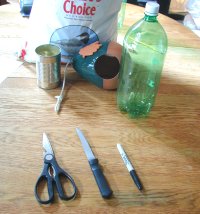
1. For materials all you need is a plastic 2 liter bottle.
For tools you will need a marker, a sharp pointed knife and a pair of scissors.

Almost any type of scissors will work, just don’t use the expensive ones your wife uses for sewing.
If you do then filling the feeders with be the lest of your problems.

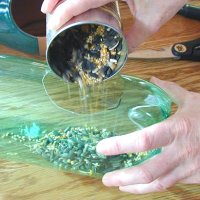
A soup size tin can is used to charge the feeder filler.

feeder filler 1

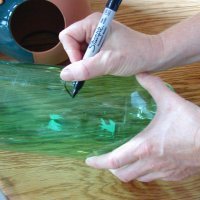
2. Draw a circle on one side of the bottle with the marker.

Make the about 2 inches from the bottom of the bottle.
Just freehand it.

If you want you could use anything round to trace a circle on the bottle.

Stop sniffing the marker.

feeder filler 2

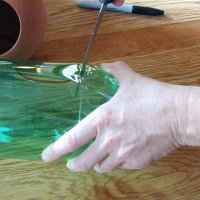
3. Carefully start a hole in the bottle using the sharp pointed knife.

Be really careful.

The best way to do this is to position the knife at the bottom of the circle which should also be at the bottom of the bottle.
The formed bottle bottom makes this spot the most ridged of any spot along the side.
Use a quick thrust making sure the sharp part of the knife is facing away from your hand.
The object is to make a small slit 1/2 to 1 inch long where the scissors can start the cut.

feeder filler 3

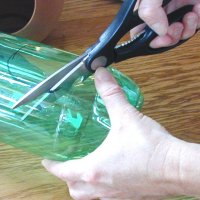
4. Use the scissors to cut around the circle until you have a hole in the bottle.

You could use the knife to make the cut but the scissors are easier and safer.

Make sure you recycle the scrap that was cut away.

What ever you do, don’t put plastic in refuse you are planing to burn.

feeder filler 4

5. A soup size tin can works great for charging the feeder filler with seed.

Any type or size wild bird feed works.

The filler is especially good for filling tube thistle feeders, especially the cloth socks.

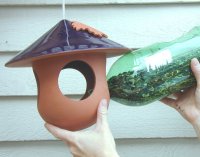
Leave the cap on until you are ready to fill a feeder, then replace the cap to keep the seed from falling out of the hole.

Feeder filler 5

6. Keep the hole on top while you fill the bird feeders.

You could use a larger or smaller bottle depending on the size of your feeders and your ability to handle a large bottle.
Keep the filler and the soup can right in with your bird feed.

Always use fresh feed and keep it covered and dry.

Metal cans with locking lids prevent rodents from getting into the feed bin.

feeder filler 6

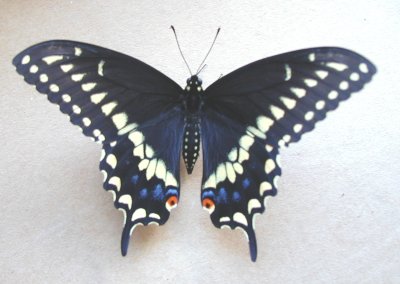
Swallowtail Butterfly

One of the nice things about gardening is that it’s not all about gardening.
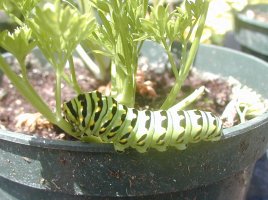
Last summer while watering the dill plants we found a caterpillar. Although we like to think of ourselves as up to date in the bug department we went to the Audubon book for an identification. It turns out it was a swallowtail butterfly caterpillar.

swallowtail caterpillar

The butterflies lay eggs on plants favored by the caterpillar, in this case dill. It turns out that the swallowtail prefers plants in the Umbellifer family which included dill, parsley, fennel and carrots.
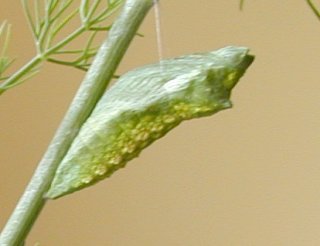
We brought the dill in to a safe spot so we could watch the whole affair with out interference from a hungry bird. In just a few days the caterpillar attached to the plant with 2 silken threads and began to harden into a chrysalis.

swallowtail chrysalis

We watched for about 10 days and then with out warning the butterfly emerged from the chrysalis. We looked around and soon found the butterfly on the window sill. It had dried it’s wings but was not quite ready for flight so we removed it to a sheltered part of the garden and left it alone.
Here is a picture of the swallowtail butterfly on a piece of cardboard as we were moving it to the garden.

swallowtail butterfly

Next season we will keep a sharp eye out for the caterpillars and we will tell our customers to watch for them as well.

Visitors to the Garden

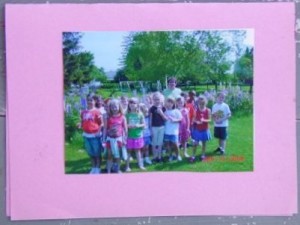
A week ago last Monday we were visited by a mob of 1st graders, most welcome visitors to the garden.
Early that morning one of the teachers from the Theresa Elementary School which is just around the corner from us, came with a request. “Could she and another teacher bring the 1st graders over for a visit?” Who could resist a visit from first graders !!
2 or 3 times a week young students parade by, hand in hand, for a walk around the block. We had often thought of inviting some of the children over but we never seemed to get the chance and now. here they were.

The teacher was Mrs. Walentuck and the other teacher was Mrs. Howard and they were in charge of about 35 or more inquisitive and very active children.
The day was blistering hot, in the high 80’s and the sun was hotter. As soon as they were down back we were met with a barrage of questions; “What’s this, what’s that, can you eat this, can I have a flower, my mom forgot my sun screen…..” It was great to see them and for the most part they were genuinely interested in the plants and gardens.

We finally split them into 2 groups, Phyllis took one and I took the other and we tried to give them an idea of what was going on from what we hoped would be a kids prospective.
They stayed for around 45 minutes but had to leave because they had another class right after that. The time went by so fast and we would have been happy to have had them longer.

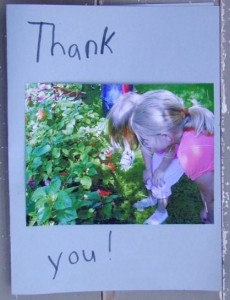
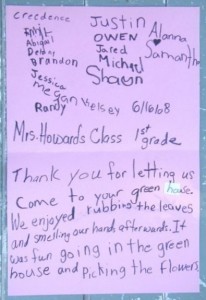
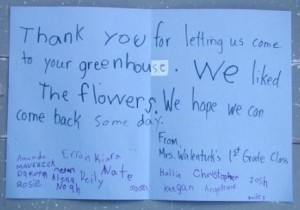
Afterward the teachers brought giant thank you cards made from construction paper and with pictures of the kids in the garden. The cards were signed by all the kids.
Here are the cards.

card 1a

card 2a
Card 1b

card 2b

Be careful in with scissors in the greenhouse.

mrs Henry cox
I was going to write a post about the foolish way that Lowes is selling flowers at this time of year but that will have to wait for a day or so.

I cut my left hand index finger with scissors as I was clipping some fancy leaf geraniums for propagation because I forgot to be careful in with scissors in the greenhouse.

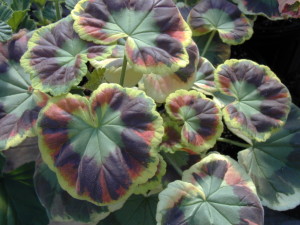
This particular plant is Mrs. Henry Cox and it has a very colorful leaf. For one reason or another we are left with a single plant and it is a few years old but has some healthy shoots that I wanted to clip for rooting.

In a case like this, when we have only one plant, we try to get the best yield without ruining the mother plant.
I was cutting into some very hard and old wood and was using quite a bit of force with the Fiskars garden scissors. All at once the scissors snapped shut and my finger was in the way.

I felt the pressure and held it tight because it was one of those times that you know it’s bad and you would rather not see how bad it was. I managed to keep the end of the finger gripped between my thumb and palm while I finished the last 2 cuttings.

Naturally my hands were covered with all kinds of dirt and were stained brown and sticky from handling the cuttings.

I came up to the house and washed my hands with antibacterial soap and dried it up. I let it bleed freely for a minute or so with the thought that this might clean any foreign material from the wound.

Then some band-aids and tape and it should be fine. The only problem is the cut is near the end of my finger and I need it to type. So I will take it easy and keep the posts brief for the time being.
I have had a tetanus shot within the past 10 years so that is not a worry. Tetanus shots are a good idea for people who work in soil and handle sharp tools. Thank God we do not have a giant wind chime order to tie.