
All posts by Tom Roberts

Frost Warning

It’s getting to that time of year when we have frost warnings. Last night and the night before were such cases. We have learned through hard lessons to err on the side of caution when it comes to a frost.
Frost occur when the temperature falls below freezing, usually at night. The frost is sometimes evident in the early morning light as a white “frosty” covering on the grass and other vegetation. This is not to be confused with a hard freeze. A hard freeze will cause damage to plants left anywhere outside, even of covered.

Tender plants such as impatiens, geraniums, and tropicals like the elephants ears, Boston ferns and vegetables like tomatoes and peppers are susceptible to frost damage. The freezing air causes leaf damage as the cells rupture when frozen. If you have ever left a can of soda in the refrigerator you will know what happens. The liquid expands when frozen and with the case of plants the cell membrane is damage and the cell dies.

Since the annual plants get their energy from the leaves the plants die.
Perennial plants, on the other hand store their energy in the roots so they may die off this year, they will come back next year. Perennial plants do not need to be covered.

Plants in containers can be moved to a spot where they will be under cover such as a porch or under an awning. Other plants such as those in large containers or planted directly in the ground need to be covered up where they are.

Materials used to cover the plants include newspaper, plastic, plastic bags, sheets or other material that can be loosely laid over the plants. If the wind is blowing its a good idea to use a covering that can be tied down but since many frosts occur on still nights this usually is not necessary.

The plants will probably need to be uncovered in the morning as the sun on plastic can cause the temperature to spike causing damage from heat. It’s a delicate balance between a quick frost and temperatures in the 80 or better but that is one of the challenges with growing in zone 4.

Time again for cool weather plants

Every year by the end of August our temperatures start the turn back to cooler. Even the angle of the sun tells us that fall is just about here.

Another sure sign is the condition of the flowers in the garden. The sun and heat loving perennials like the daisies and black eyed Susan’s are just about spent. This year we have the added effect of the pronounced drought of the past 2 months.

This morning we assessed a garden for a customer. The main planting was creeping phlox but the blooms had long since gone and what foliage that was left was beginning to turn brown. The round garden measures about 8 feet in diameter and was situated directly beneath and around a medium small 10 inch maple tree.

The first thought that came to mind was the tree should not have mulch piled so far up on the trunk. I will never understand why people insist on building a pile of mulch against the parts of a tree which are supposed to be exposed to the air. This practice can invite disease in the bark, not to mention it makes a hiding and breeding place for destructive insect. In fact it was a near by nursery who had constructed the garden in the first place. A nursery man should know better!

But that thought aside, I came to look at the plants and recommend a plan for the fall. The phlox covered 75 percent of the area with intermittent bare spots showing weather red mulch and a bit of black landscape fabric showing through.

My first recommendation was to start watering the phlox. The garden was very dry owing to our local drought and a spotty watering regime. A garden that is sheltered under a tree, as this one was, will not get much rain when we have light showers and its deprived any dew that might form at night as well. A week or 2 of regular watering will bring the phlox back and help prepare it for the cold dry winter ahead.

My next suggestion was to use the bare spots for seasonal planting. For example since we are heading into fall and much cooler weather the homeowners could plant some mums right in 1 gallon pots. As log as they are watered they will do fine in the pots. When winter inevitably comes the mums can be bunkered with a bit more mulch and left in the ground. Then in the spring the mums can be taken up, clipped back and held over for next fall. If for texture and variety some kale can be added as well.

Other cool weather plants such as marigolds, violas and pansy’s can also be planted in the fall. These flowers are often thought of as spring planting but they are really just cool weather plants. As a matter of fact we had violas growing in December last year, and this is zone 4.

After the mums are taken up in the spring the holes can be planted with marigolds, violas, or pansy’s for the spring. The phlox will be blooming very early and should hold the color until at least June after which time warm weather plants like geraniums and portulaca can be added to the mix.

By changing the plantings for the season they can cultivate their green thumbs and enjoy a wider variety of flowers.

Summers on the way out

Now that summers on the way out we make plans for the fall.

Autumn is a perfect time of year to take care of all the work we put off due to lack of time during the busy summer. And who wants to work when it is hot and sticky.

The best way to make use of the time left before the snow flies is to make a game plan and prioritize. See what wants to be done and weigh it against what needs to get done. For example bringing in the tender plants will need to be done before frost is on the pumpkin while stacking pots and putting benches away can wait until the last minute.

We must remain mindful of the perennial stocks needs this time of year when the weather can be cool but dry. The cool weather can lull us into a false impression that the plants are fine because the temperature is not hot. In our case the plants in the beds need to be watered until the frost hits.

One chore that must not wait too long is making the greenhouse ready for plants that will be wintered over. This means making sure the plants that will be brought in are pest free and those already in the greenhouse are too. Keeping plants in a year round greenhouse can be a chore especially when we are using organic pest control.

The key is to find a good product and we use pyola. When we use it in a regular schedule it controls all the pests including fungus gnats, white flies, aphids and mealy bugs. The sad part is this product also will kill beneficial insects but we find the insects did not work in our case.

In any case we want to make sure everything is in order so we are not faced with a mad dash some night when the temperature is dipping into the teens.

Backyard ponds and mosquitoes

We read an article the other day, about an outbreak of West Nile virus, somewhere in California.
West Nile virus appeared in the United States in 1999.
Although it is usually harmless to humans it can be deadly to those older, younger and with compromised immune systems. Backyard ponds and mosquitoes seem to go together.

It seems California is experiencing the largest outbreak in history.
Part of the problem seems to be back yard ponds and water gardens. The fairly recent proliferation of water features is adding to the already handy spots that mosquito’s use, such as old tires, pails, and any where water gathers.

Our cold climate and icy winters does not exempt us from the problem and danger of West Nile and other mosquito borne diseases. And we do not wish to abandon our water gardens.
There are a number of solutions to the problem from floating oil on the water to larvicides but the one we like the best is the mosquito fish but there are dangers associated with using the fish to control the larvae.

The mosquito fish are very competitive and invasive so it is very important that they not be released into free running streams and bodies of water where they would compete with local indigenous species.
Goldfish will also eat the mosquito larvae and are another choice. As with the mosquito fish do not release the gold fish into local waters.

In the mean time keep your property free from any container that would provide a breeding spot for insects. Hundreds and thousands of mosquitoes can breed in a pail of stagnant water.

Tuning up plants

It’s well past the 4th of July which is the date we target as the end of annuals. This year we continued to sell them into the middle of the month especially to summer residents who are looking to fill a spot. As a matter of fact we will stagger some of the marigolds and zinnias as well as some of the potted vegetables just for the people who come up late.

Anyway by this time of the year the herbs in-the small pots are choked up and trying to blossom. SO today we went around and trimmed everything back as well as dead headed what is left of the geraniums, essentially tuning up the plants. They also suffer from being stuffed into small pots so we intend to put some of them in larger pots and if nothing else we can keep them over for propagation starts next spring.

Strange though the zinnias in the ground around the herb garden are doing very poorly while the ones we potted up are doing fine. The only difference is the potted versions get more attention and are watered consistently while those in the ground are more or less left to fend for themselves. A smattering of water now and again is no enough. They really need a deep soaker, which we had the past weekend so we will see how they fare.

The perennials continue to sell at a marginal rate. The weather was so good this weekend that we only sold a few and Jenessa who works in the outdoor plants at Lowes said they were very slow the past 2 days so we don’t feel too bad.

The one thing that does make us feel bad though is the fact that the big box stores are getting the mums in already. Here is is almost the middle of summer and they are getting ready for fall. They will not let us forget for a minute that the warm weather will only be with us for a while before the snow flys.

Nobody is forcing us to live here but we sometimes like to gripe.

Middle of Summer Chores

Now that the annuals, save the geraniums are all finished, things have wound down to the middle of summer chores. Keeping the perennial starts watered is number one followed closely by keeping the bedded perennials watered. We can get some hot days and its surprising how fast a gallon plant can dry out.

And it’s not just from evaporation. Plants breath, that is take in atmospheric gas, separate it into what they need and don’t need, then utilize what they do need and give off waste gas. This is one of those things I learned in high school biology. You know one of those things I would never use in real life?

Strange enough plants have tiny openings on the under sides of their leaves where they breath.
The point is when the plants give off gas they also give off moisture. Not exactly like humans or other animals but it’s the same idea. And this contributes to how fast a plant dries out. And conversely how much and how often we have to water.

Many of the hosta are blooming, primarily those in the shady garden. Those in pots are not blooming but they do look nice. We had a problem with snails in the hosta just as we had them in the lettuce. Coffee grounds seemed to work for the lettuce and so we are trying that on the hosta as well.
But that’s a topic for another day.

Annuals done for the season

We have finally taken almost all the annual flowers down for the season. We were left with just a few marigolds, dusty miller and portulaca. We will keep some of the gazania daisy and geraniums until they are gone but for the most part the annuals are done for the season.

We also have finally figured out the ebb and flow of business with the respect to summer residents. We live in an area that has a huge influx of residents and they come back in several waves.
The first group to return are the snow birds. This group is primarily retired people that live in another place for the winter and return north for the summer. Snow birds come back by tax season and get their gardens planted by normal standards. In by Memorial day unless cold weather is threatening. This year was like that and we only got the village flowers out a few days before Memorial day. I guess a few people were nervous.

The next big group comes up when school gets out and they are made up of working people with children in high school or college. They return by the end of June and the beginning of July.
There is another group and they trickle back as they can. These are the weekenders who have cottages and camps through the area.

The snow birds are easy to grow for because they fall into our normal growing pattern. They buy the same times as the local residents. The other 2 groups are a bit more of a challenge.

The later group wants annual flowers and some vegetables later in the season. In the Past we simply tried to keep the annuals dead headed and in the small 6 packs but the roots get bound and the plants suffer. It is hard to keep a plant hydrated in the small packs and they are too crowded as well.

The solution is to simply start a crop of annuals about a month apart. This way the later crop is in selling prime for the end of June. There is a good market for the later annuals and this year customers were looking for them even this week.

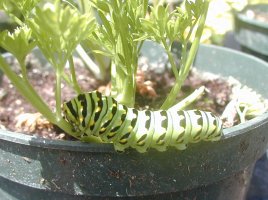
Oh and by the way the caterpillar is changing. He attached himself to the plant and look what happened.

caterpillar 3

How to ruin a greenhouse

$1000 greenhouse + backhoe = $50.00 greenhouse equals how to ruin a greenhouse.

For the past week or so I have noticed a boat trailer parked by the side of the road that we take when we go to Alex Bay. Friday I noticed there was a car in the driveway and so we stopped to ask about the trailer.

We have a 1951 Feathercraft deluxe runabout which has a trailer but we also have a 1961 Lyman and a 57 Chris Craft Continental and they do not have trailers. So we are more or less looking for trailers.
When we pulled into the driveway we were greeted by a young lady, the lady of the house as it were. She was stepping out of a travel trailer and went over to turn off the generator that was situated near the travel trailer.

It turns out the young couple recently bought the house and land at a tax auction and they were living in the travel trailer with their 2 young boys and a German Shepherd dog.

Anyway she said the trailer was $30.00 but for an extra $10.00 they would throw in a boat motor. We looked at the boat trailer and sadly it was in such poor shape that I would not have taken $30.00 to remove it from the side of the road. But I was intrigued by the motor.

The young lady led us into the back lot where the boat motor was stored in the middle of a field. It turned out to be an old 16 hp Oliver out board and it was complete. I figured the prop was worth $10.00 so I agreed to the price.

On the way back to the car we passed a pile of rubble with what appeared to be some pipe protruding from the sides. They looked like greenhouse hoops. Hey, I said, those look like greenhouse hoops. Yeah she said, with out much emotion, my husband cleared off the land and there was a greenhouse but we could not get anyone to come and take it down so he knocked it down with a bobcat and we are going to have the fire department burn everything.

After looking at the pile we determined we could salvage at least 5 of the hoops and offered him $50.00. Long story short, well too late for that, but after spending about 4 hours sawing, digging, prying, sweating, cursing and getting rained on we had the hoops home. That would give us enough material for a 30 foot tunnel for baskets next spring.

It’s too bad though, because if he had advertised the thing for sale he could have sold it for and easy $500.00. Not to mention the benches, and multitude of pots, flats, trays and the like buried together with tires, trees and tons of sod.

By the way we are posting the progress of a swallow tail butterfly caterpillar we found on some fern leaf dill. Seems they like it and there we 2 but by the time I got out to get them one was gone. I will post photos each day until the butterfly emerges. This is the first photo.

caterpillar

I need to be more people

For the love of Pete when I started this blog I was determined to make a post each day. That was my intention. But it has been said that the road to hell is paved with good intentions. I need to be more people for sure!

To catch up. The farmers market at the Bay is going swimmingly. There were more vendors this past week than any week this season. Many vendors had local strawberry, rhubarb, beets, greens and what appeared to be trucked in vegetables from Syracuse. ( one of my pet peeves but this is not a perfect world so I let it go. )

I still do not have the full list of farmers markets posted on the site and I wished I had more time. Most of my spare time has been spent on the wedding site. I am in the middle of a total re-write and since we depend on the traffic for our lively hood the wedding seo comes first.

We are down to just a few flats of annual flowers. Some marigolds, dusty miller, verbena and some of the ivy that got nailed by frost. The ivy did not come back but the geraniums that were hit are now looking very good and selling well.

We are taking the larger 4 inch geraniums and potting them up into 1/2 gallons. This makes them look better and they sell better too. We use a little nutricote time release fertilizer on the transplants to keep them healthy.

Our target to be done with the annuals each year is July 4 and it looks like we will be able to make it.
We will keep selling herbs, baskets, geraniums, hosta and perennials for rest of the summer. This does not take as much time as doing the annuals and leaves us time to get the next seasons crop of perennials going. It is remarkable how well the perennials look after wintering over in the gallon pots.

This year we simply nested them together in raised beds and covered them with straw. This was a bad plan because the straw was full of seeds and it also made a good place for the voles to hide.
They ate a good number of plants by the root and chewed a lot of pots up.

This year we are going to bed them inside pine mulch so that each pot is entirely encapsulated, hopefully making it hard for the voles to move from one pot to the other. We will see how this works.

Alex bay NY farmers market report

We finally made it to the Alex Bay farmers market last Friday and here is the Alex bay NY farmers market report. I say finally because we have been tied up the past 2 weekends and were not able to attend.

We sold perennials, annuals, hosta, hanging baskets bird feeders and herbs.
The new location is at the Kinny Drug parking lot but the set up is in the grass beside the parking lot in the margin adjacent to NYS Rt 12. This spot is better than the prior location, which was across Rt 12 at the information booth lot for the following reason:

1. People walking from the Bay do not need to cross 2 lanes of traffic and the market is closer to the village.
2. NO GEESE. Goose droppings made the other location messy.
3. There is a dock serving the St. Lawrence River and boaters can make it over from the islands.
4. Plenty of parking for customers and vendors, and the store has a place to keep the signs. Customers these days want to park where they can see their car and many of the customers are elderly and infirm. The handicap parking affords them the ability to park where they only need to walk a few yards.
5. More buyers from the busy drug store and bank shoppers. Vendors need to make sales and good sales insures quality vendors. As with a poorly run craft show you can always find vendors but the quality vendors will not return if there are no sales. They can just as easily sell else where. With out customers the show or market in this case would end up with vendors who have less to offer in the public. In that case the public will not continue to support the efforts and the customer attendance will drop off.

This is especially true of a small market with out a secondary draw such as the State Office Building at the Watertown Market.

6. Retained visibility and increased safety. The prior spot had traffic passing at high speed and there were numerous incidents and near misses. Here the traffic is just coming through a light and going much slower to begin with.

We has a good day selling and we were able to hand out more literature hopping we can coax more visitors to the greenhouse. We are hoping that investing the time to set up with help insure the markets success and pay off for us in advertising as well.

Every customer we asked thought this is a better location.

I will go out on a limb and predict this could be a very popular market attracting dozens of vendors and thousands of shoppers.