All posts by Tom Roberts

Ice build up on greenhouse door

When the temperature falls below 0 degrees F, we can have a problem with ice build up on greenhouse door can be a real problem. The moisture from the warm moist air inside the greenhouse tends to condense on the thin aluminum skin of the door and door frame.

This makes it hard to open the door and even harder to get the door to close. For now we point the heater toward the door for an hour or so while we go about our business. This keeps the door clean and in good shape.

Last year we attached a layer of insulation on the bottom of the door and that worked for a while but the real trouble is the type of door we use. It’s an aluminum combination storm door that is meant to be used in addition to a regular wooden or steel door.

The best solution to this problem would be to use a heavy insulated door during the winter months. The walls hardly ever get frost because both ends are insulated on the inside with 2 inch foam insulation.
The only other place we get frost is on the steel louvers and this can be a problem, especially when the sun is very bright in February.

During the night the cold air outside causes the ice to form on the inside of the louvers and they freeze shut. Then when the temperature goes up in the day the motors are stressed trying to open the frozen louvers. The best we can do is to keep the fan set at a high temperature and keep the louvers coated with WD40 to help keep the water and ice from attaching to the metal.

How to get rid of a Christmas tree

Now that the holiday is over the big question is “how to get rid of a Christmas tree? You remember, the one that we tried so hard to keep fresh.

This year it we picked a really fresh tree and to this date, it has not dropped any needles. Which is a good thing because there is no big mess to clean up but bad because we have less incentive to take the tree down. However the tree is occupying the space normally used by the tread mill and we are not getting the exercise we should be getting to one way or another the tree has to go.

The easiest way to get rid of the tree, at least around these parts, is to leave it at the curb and it magically disappears. I don’t know if the tree elves come and take it away or if it is just the village department of public works but what ever the case the tree disappears in a few days. Unless we have a snow storm, in which case the tree gets buried in a snow bank that may well not melt until spring. Around here spring can fall anywhere between April and July so the tree may be here for a while.

Another way to use the tree is to stand it up in the yard and hand wild bird treats from it. The branches and needles form a nice cozy hiding place for the birds. Then in the spring we simply take the tree and pile it up with other brush along the edge of the woods.

Christmas trees make good mulch but grinding one up requires a mulcher. We have a really nice one but it usually is buttoned up for the winter so the tree would need to be stored until the spring. Then the mulcher could be brought out and the excess brush could be turned into mulch along with the Christmas tree.

I remember reading somewhere that bass fishermen in the south will tie a cinder block to a Christmas tree and sink it in a pond or body of water to provide shelter for fish. This sounds like a good idea at first but the prospect of loosing an expensive fishing lure to a submerged tree is not so appealing, not to mention the fact that cinder blocks are usually not free.

Personally we like the idea of the bird feeder tree. We paid $40.00 for that sucker and we want to get as much use and enjoyment from it as we can.

How to keep the Christmas tree fresh.

We are determined to have a fresh tree for the Christmas season. When I say fresh I mean as opposed to an artificial tree. We have nothing against the artificial trees but we prefer the real tree.
When I was very young I had a next door neighbor who had many allergies and evergreen trees was one of them. I remember how they had a tree made from shiny aluminium and it was lighted by a color wheel that rotated with different colors, one after another. It looked high tech and more like something out of a science fiction movie.

The first tree I really remember getting was with my parents. It was night and we were buying the tree from a yard in the nearby city. Back then most people heated with coal and the smoke was dense and hung close to the ground all through the neighborhood. My parents drove some type of sedan with a large trunk and the lid or lock was frozen. The man who was selling the trees from his front lawn brought a tea pot of hot water to thaw the frozen lock so that they could bring the tree home in the trunk.

For years we had the fresh tree with the large old fashioned lights. I guess at the time they were not really old fashioned but compared to today’s LCD lights they might as well have been candles. My dad would get the strings of lights out every year and go through them to see what ones worked and what ones did not. A few strings were wired in series which meant if one bulb was out the whole string was out.
That meant going through the whole string one bulb at a time to see which one was the culprit. Each bulb had to be removed and replaced with one that was new and hopefully in good condition because if it was a dud then the whole exercise would need to be repeated with an other bulb and plenty of cussing and fuming.

But I digress…
We like the fresh tree and there are a few things we do that may help to keep it fresh until we ditch it.
First we try to choose a fresh tree.

To begin with because we live in a zone 4 climate several factors work against us when we try to see how fresh a tree is. One is the tree its self. Spruce, Scotch Pine, Balsam and all evergreen trees. They don’t loose their needles easily and the ones that are dead stay green for quite a while unlike say a maple tree whose leaves would wilt and die in just a few days. The second is the temperature that is usually fairly cold. As a matter of fact last night it was at least 15 degrees below 0 Fahrenheit. The cold keeps old trees in a suspended state where they stay together but can continue to dry out.
So how can we know it’s fresh? I pick it up and slam the trunk into the ground and see if the needles fall out. It’s a dramatic exhibition but only about as accurate as kicking the tire on a used car.

A better way is to fold a small branch end over on its self and see if it breaks or springs back. If it is very brittle the tree may be old. Also stripping a small branch to see if the needles fall off can indicate how much the tree is likely to shed when it is brought indoors. Usually we end up picking the one that looks the best regardless to any other factors. After all who wants a tree that has 3 trunks and misshaped limbs.

We might buy a tree 3 weeks before Christmas but we usually do not bring it indoors until about 2 weeks before. If it has been cold we bring the tree in and lean it up to let the branches “fall”. The trees are usually packed together for shipping and in some cases they are wrapped tightly so that more trees can be packed on the truck with minimum damage. This wrapping of the fresh cut green tree forces the branches against the trunk and when the tree is brought into the warm house the branches will fall back to a more natural shape.

After the tree thaws out we stand it up and trim any branches that are out of place and while we are at it we trim at least 1 inch off the bottom of the tree. The theory is this will open fresh pours in the wood (xylem and phloem) that allows water and nutrients to go up and down the tree. Then when the tree begins to dry out the water will be drawn up into the tree to help it stay supple. Now that I think of it I am not absolutely sure that the water in the tree stand goes up the tree or into the air, or the cat for that matter.

Anyway the tree is up and it will stay even if the needles begin to drop because more than likely it cost in excess of $30.00 and who wants to throw 30 dollars out?
And after all it was a living tree before someone cut it down and what more can we expect from a dead tree in the living room?

Proper watering of container plants.

Or how to keep your baskets and containers from dying from lack of water.
If there is one thing we as animals share with almost all plants it’s the need for hydration. In short we need water to carry on life. Our bodies contain a large amount of water that is used for everything from cooling to waste removal. In a similar fashion plants rely on water too. Most of the plant nutrients are carried from the roots to the tops of the plants with water. So it pays to know proper watering of container plants.

There are some plants such as indoor jade plants and cacti that do well with only a very small amount of water, but most ornamental perennials and annuals need more, especially those kept in containers or window boxes. The limited space in pots and containers allows only a finite amount of water, assuming that the container has drainage holes.

Just as the plants need water, too much water can kill plants. The roots become drowned and can not breath. Drainage holes keep the containers from being waterlogged. In addition to drainage holes most containers should have some type of open drainage material such as crush stone or pea gravel. Some gardens use pieces of broken pottery to supply a drainage zone in the bottom of the pot.

The type of soil is also important. For example a heavy clay soil dug from the back yard might seem like a cheap alternative to expensive potting soil. The problem comes from the fact that heavy soil will not allow the water to migrate thorough out the container. Likewise the roots will not be able to breathe as well and the plants will suffer. Not to mention the trouble with weeds and plant pests that accompany the garden soil.

If buying potting mix is out of the question, a good option is to use compost mixed with garden soil, or good compost alone. This will supply nutrients and help the roots stay in good condition.
There are some commercial additives that are thought to help keep plants watered through times of drought. These are classified as hydrogels. Hydrogels are usually small granules that appear much like quartz crystals when dry and can absorb many times their mass in water. It has been thought that the hydrogels would hold water when wet and then give off moisture to the soil as the soil dries.

Having purchased plants that were potted with hydrogels we were dubious. In many cases, when re potting plants that were potted with hydrogels, we found the soil to be very dry while the little gels were not. If they were squeezed between a finger and thumb they yielded no water what so ever. As a matter of fact the University of Minnesota did a study on hydrogels and water availability which showed that plants potted with hydrogel did no better with those potted without them.

One of the biggest problems with watering container gardens is the varying needs of different plants.
There are some products that may aid in even watering. Wetting agents can help the water reach every part of a container. This is important because the roots will grow where they find water.
The greatest challenge in watering containers is making sure the plants do not completely dry out between watering. It is probably not a problem to let plants become a bit dry between watering but the soil should not be allowed to become bone dry.

If the container becomes bone dry the soil should be deep watered to re-hydrate the roots. Water will pour through very dry soil so it becomes necessary to do several deep watering’s to be sure the whole container is wet.

Planting Tomatoes

Now that we are reasonably sure the cold weather is behind us it is time for planting tomatoes. In our zone 4 region there is a real chance of frost right into June so we always have to keep an eye on the weather. A frost could easily kill an unprotected tomato plant so we wait until it seems safe.
Our tomato garden really began last fall when we planned what variety we would grow. In the past we grew as many as 8 different varieties for sale but this year we grew only 4. Supersweet 100, Oregon Spring, Better Boy and tumbling toms. The supersweet 100 is a cherry tomato and they produce tons of fruit.

Unless the family is large, 2 or 3 of these will be all you can handle. The Oregon Spring is an early determinate variety that is good for containers. They produce 2 to 3 ounce fruit. Better Boy is a standard beef steak variety that will yield large slicing size tomatoes. Tumbling toms are a hanging tomato that are supposed to work well in baskets and this is the first year we are growing them so we will see.

We also grew husk cherry and tomatilla, both related to the tomato. The husk cherry produced a grape size fruit that is very sweet and the tomatillais a green variety that is used in salsa and Mexican cooking. The fruit from both of these is encased in a paper like shell that is discarded.

A word on hardening off. It is a good idea to make sure before planting tomatoes, or any plant for that matter, the start is strong enough to handle cool weather, raw wind and bright sunshine. Tomatoes need full sun but many store bought tomato plants have never seen the out of doors so the safe thing to do is harden them off before planting. To harden the tomatoes bring put them out doors. If the wind is blowing hard make sure they are protected. If the sun is shining then leave them in the shade for the first day. Then increase the time in the sun and wind a few hours each day for a week. Now you plants will be better equipped to stand up to the ravages of nature.

To start the garden we tilled up a spot where we grew glads last year. We like to rotate the tomatoes to avoid disease problems. There we a few weeds and some grass growing in the spot so after we tilled the area we raked it fairly clean with a garden rake. If the garden were free from grass and weeds we would have been able to plant it right after tilling with no raking because our trusty old Troy Bilt tiller leaves the ground level and ready for planting.

raking ground for tomato

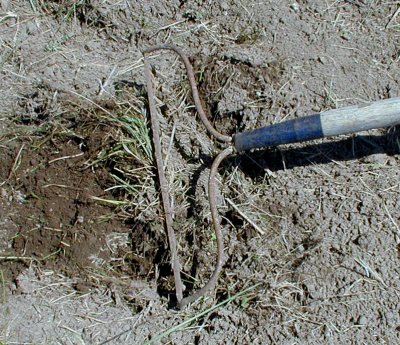
Rake the soil free of weeds

After everything is cleaned up a level the planting begins. We like to plant on a cloudy day or later in the after noon so the plants will not be in full sun right away. As to the phase of the moon, that is up to you.

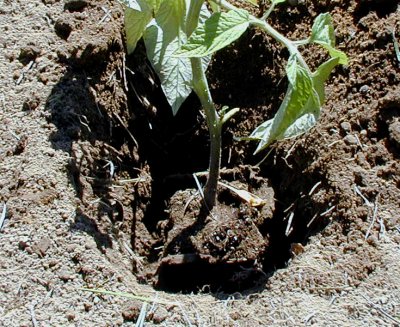
Check the tag or other source to determine how large the plant will get and how far apart to plant them. Next dig a deep wide hole for the plant. Make the hole wide and deep enough to plant the tomato right up to its neck.

dig hole for tomato

Dig a deep wide hole for the tomato plant.

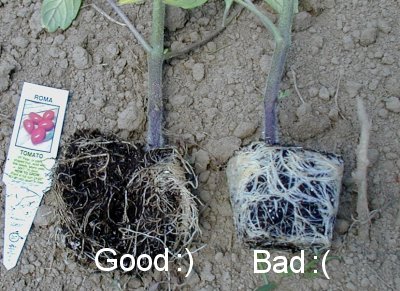
There is a good chance the plant will be root bound after spending weeks on the growers shelf. This happens when a plants roots outgrow the container. As the roots grow longer they grow in a circle as seen in the plant on the right. If the roots are left like this they may continue to grow in a tight circle, restricting growth and limiting the ability of the plant to absorb water and nutrients. Carefully tease the roost apart before planting. This should not hurt a tomato plant, in-fact it helps free the roots so they will continue to grow in a more natural fashion.

teasing tomato roots

Tease the roots out

By the way tobacco use is bad for people are really bad for tomatoes because of the tobacco mosaic virus. Don’t smoke in the garden, better yet, don’t smoke tobacco at all. If I can quit anybody can.
Once the plant roots are teased apart the plant is placed in the nice big hole. At this point some people fertilize the plant but we wait and top dress them after the shock of transplant has passed. Any of the lower leaves can be plucked off.

bury tomato plant

Bury the plant up to it’s neck !

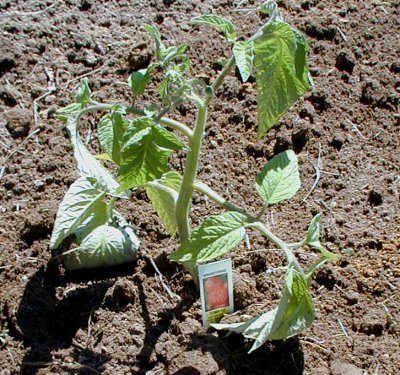
Now fill the hole in all around. Put the tag next to the plant or record the location of individual varieties. Water the plant and keep it watered for the next week.

tomato plant

Fill the hole in all around.

At this point the plant is at the mercy of the weather, and wild or domestic animals. The urge to staking the tomato now may be strong but buck up ! If the plants are allowed to brace against the wind they will be stronger for the effort. When they begin to branch out and grow taller you may find supporting the plant, which is heavy with fruit, is necessary but for now let the plant grow strong.

Starting and growing Lilacs

Of all the trees and shrubs that bloom in spring, not many are able to match the colors and fragrance of the lilacs. It’s a good thing starting and growing lilacs a fairly simple job. They seem to be stimulated to bloom by warm weather and this year we have had sunny days and warm temperatures.
I think of the lilac as an old fashion type of tree/shrub as they have been around for quite a while. Often when riding in the country we can see a tight grove of lilacs all by themselves. At one time there was probably a farm house at this location and all that is left are the hearty perennial shrubs and flowers. Usually one can also find a few patches of day lilly’s at one of these location, but they are not blooming now.
There are 3 colors of lilac on our property. White, lavender and deep purple. We planted some of them but we were very fortunate to have a dark French lilac growing outside the kitchen window. The ones we planted came from suckers we dug up from relatives and it seem like the white and lavender send out shoots with abandon. The French, on the other hand do not seem to send out anything, which makes them all the more desirable.

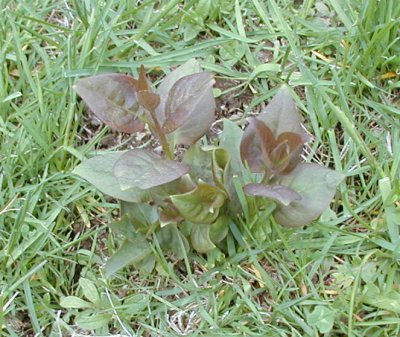
Here is an example of the deep purple lilac.

french lilac

French lilac

The French lilac does not seem to send out as many suckers, or new plants as do the white or the lavender. One way to get a cutting is to bend a branch down to the ground and bruise the bark at a spot where a new shoot is attached and cover it with soil. In time and with luck roots will develop on the shoot and the whole thing can be cut free from the main plant. The cutting is potted up and keep moist until the root system becomes stronger. Try making a small cut where the soft wood joins the hard wood stem and apply some rooting hormone. The best time to do this is in the spring when the growth is rapid.

Another method is taking a soft wood cutting. On the lilac branch there are 2 distance regions. The hard bark covered area is called the hardwood and the smooth new growth is the soft wood.
Soft wood cuttings can be started using potting mix and root hormone. Take a soft wood cutting at least a few inches in length and remove the lower leaves. Dip the stem in rooting hormone and put the softwood cutting in a pot filled with peat based potting soil. Keep the cutting in the shade and keep it moist but not too wet. Some growers cover the pot with a plastic bottle that has had the bottom cut off. Be warned the pop bottle will keep the moisture in but can also create a greenhouse effect that can cause the temperature to rise and kill the plant.
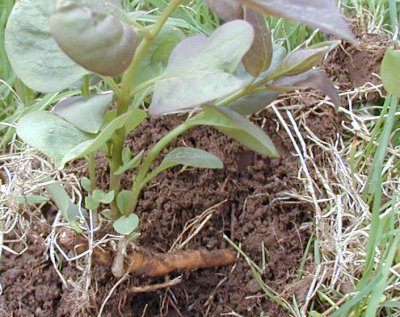
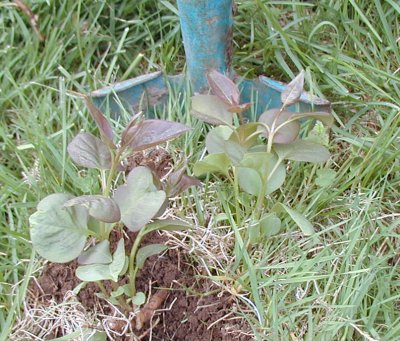
Taking cuttings from suckers is much easier and is usually more successful than soft wood cuttings. Look on the ground around the lilac for new shoots.

lilac shoot.

lilac shoot

Take a shovel and insert the blade on the side away from the mother plant, lifting the shoot. Just lift the shoot to expose the root that attaches the shoot to the mother plant. Carefully remove the soil from the clod of soil to see where the root goes.

lilac root.

lilac root

Next take your shovel and sever the root between the shoot and the mother plant. Then the root can be lifted out and planted in a pot of pro mix. Keep the cuttings in the shade and make sure they stay damp until the roots have a chance to strengthen.

lilac cutting

lilac cutting

The larger the cutting the deeper the hole. Try to keep the roots protected until they can be planted.
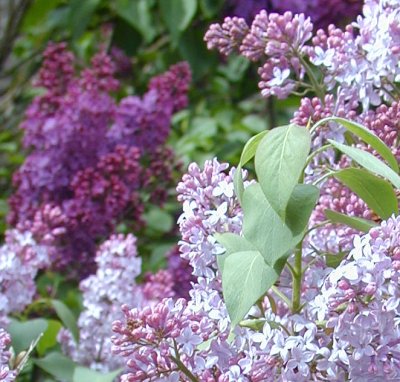
Many of the planting on our property were unceremoniously dug up, dumped in a pail and planted right into the ground. Lilacs will grow fast and the deer do not seem to bother them.
Here is one last photo showing the contrast between the violet and deep purple lilacs.

violet and purple lilacs

two color lilacs

Waiting for the best weather to plant

Planting the garden or flowers requires a bit of pre-planing if we are to be successful at all and Waiting for the best weather to plant can be the hardest part.The planning is just part of the fun but how well we plan can make the difference between a great garden or total failure. The big question is what is the best time to plant the garden or flowers.

We live in a zone 4 growing zone and that means we can get a frost up to the end of may. We have grown here for many years and our experience tells us that the weather may be nice but it can change very quickly. We have had snow on the fourth of July.

The past few days the weather has been very pleasant and today the temperatures went past 80 degrees. This was a record but by only 1 degree. The point is this warm weather can fool people into thinking it is later in the season than it really is. All day today I kept thinking I was far behind and then I would remember that its the middle of April.

We needed some hardware and stopped by Lowe’s to check out the plants and we were surprised to see there were tomato and pepper plants ready. They also had petunias and geraniums out. I had to wonder what would happen if a freeze hit. But they use vendors who supply the plants and that also explains why they are usually in poor shape.

The big box stores and grocery stores could care less about planting dates and zones. We were looking at a very nice plant and it claimed to be a perennial but when we looked at the cold heartiness we found that the plant was suited for temperatures of 10 degrees to zero Fahrenheit. Not at all suited for this area where the temps can go to 30 below.

We take pride in the fact that our customers know that planting early is foolish and can be a waste of money. So we take advantage of this nice weather to take care of all the early garden chores like cleaning out the perennial beds and so forth. Unless they have changed the calendar there will be plenty of time for the garden.

Starting and growing Vinca Vine

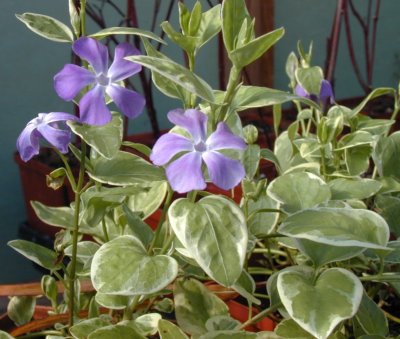
Vinca vine is a trailing plant with heart shaped leaves that are green, gold and cream colored. The leaves grow from the vine in un-paired units getting smaller until they reach the tip. The flowers are a really nice blue lavender. Vinca vine is a standard addition to many hanging baskets and is used only as a annual around here because the vinca vine is more suited for zone 7 than our chilly 4. This shot does not show the trailing aspect but we will add some more photos in a day or so.

One way to make sure you have enough is to learn the tricks and techniques of starting and growing vinca vine.

Vinca Vine

Vinca Vine

The vines can trail down 24 or more inches and it sends out new shoots from the root cluster as the season wears on. Even though the vinca is a zone 7 plant we find it can be wintered over in the greenhouse and this year we had good success at propagating them.
We started with a season end root clump. The root cluster is tightly bound just below the surface but we found that if we were careful we could carefully cut and tease the shoots apart in to separate plants.
We potted the separate plants with roots into 4 inch pots with Pro_Mix and kept them damp, not wet. Phyllis treated them with a low nitrogen fertilizer until they became established.
Now the plants are about 6 weeks old and sending out new shoots. We treat them with a evenly balanced fertilizer and give them the 10 day treatment with pyola oil like everything else in the greenhouse. Once a month Phyllis treats everything with Serenade to reduce the chance of fungal and mildew.
In-addition to the rooted shoots I took some stem pieces with 6 leaves and pulled the bottom 3 off. Then I dipped them into a rooting hormone and buried the bottom 3 nodes in Pro_Mix and kept them damp. A good number of them have developed roots and are showing signs of leaf growth and new shoots. It looks like the old 3 leaf stems are supporting the new growth and I probably will clip them back after some new shoots get started.
Over all we have found this to be a successful experiment in where we have turned one shaggy vinca vine into 20 healthy new ones. A few years ago we tried to get some started but were unsuccessful, probably do to the advice we were following. Somewhere we had read that a good rooting mix included peat and sharp sand. We mixed it up in the proportions suggested and even though it seemed a bit heavy we tried it and the experiment was a failure. The sand makes everything too heavy and does not allow water to pass through. We also tried to mix pearlite in with the peat but that was a mess and it did not hold water. Now all we use is straight Pro_Mix BX and we have no trouble at all.

Pro Mix

pro mix bail

The bails weigh about 75 pounds and one bail will fill 100 gallons. Read more about it at the Premier site.
Next winter we will probably try for more vinca vine.

Starting and transplanting tomatoes

Starting and transplanting tomatoes can be a time and labor consuming task, but with the right method its fun too. In this method we start with a 10 by 20 plastic flat with drainage holes in the bottom. These starting flats will fit in a regular 10 by 20 daisy flat, or a web flat, named for the web design. It is important that these containers are cleaned to remove any disease organisms, pests or seeds. We wash them with a bit of dish soap and disinfect them in a 9 to one water and Clorox mixture.

In a separate container we wet the starting medium, in this case Pro-Mix bx. This is a sterile medium that is well suited for starting tomato but it must be wetted before it is used for ease of handling. The dry Pro-Mix is poured into a pail or wheelbarrow and water is added and mixed in until the medium is damp enough to hold into a ball in hand but not so wet that water can be rung out.

We put about a inch and a half of starting medium into the flats and level it with a 8 inch plastic putty knife. We then use the knife to make rows the long way in the flats by pressing the blade into the medium to a depth of no more than 1/2 inch. There is room for 6 or 7 rows across, depending on how close we make them.

Now we plant the seeds. Tomato seeds are fairly small, but not too small that we can not use our fingers to drop them one at a time into the trench made with the putty knife. Another way to plant them is to pour a quantity of seeds into a “V” of paper made from folding any kind of paper in half. Then the seeds can be tapped out one at a time using the end of a pencil. We plant the tomato seeds no closer than 1/2 inch and usually closer to 3/4’s of an inch apart.

When we finish with any particular variety we mark the rows right away, with a tag so that we can keep them separate. If the flat is all one variety it is easy but if we have 2 or 3 in a flat it becomes necessary to mark them because they all will look more or less the same when they start growing. I can still hear my father cursing a nursery where he thought he was getting big boy tomatoes and ended up with some kind of yellow cherry which are nice tomatoes but a poor replacement for the big boy.

We back fill the trenches by pinching the soil in from the sides of the little trenches and we give them a very light sprinkle of water from the small watering can. Now we cover them with clear cling wrap and put them where they will be warm, in our case on the front of the benches that are heated from below. We keep an eye on them during the day when strong sun can raise the temperature of the clear wrap covered soil to more than 100 degrees F. If it looks like they are getting too hot we uncover them.

Every day we raise the edge of the wrap to see if anything is starting and to make sure they are just damp. As soon as the seedlings begin to appear above the soil we remove the wrap and make sure the flats are in direct sun. We want the seedling tomatoes to grow strong. We are also careful with water. If the soil is too damp molds and fungus can appear and this can cause the plants to “damp off”. Damping off is a term that describes the condition where seedlings rot at the soil level from fungus or molds. By starting with clean flats and fresh Pro-Mix we greatly reduce the likely hood of this occurring, in-fact we have never had the problem with tomatoes.

The emerging tomato seedlings will have one set of narrow and sharply pointed leaves as they begin to grow. Within a week or so the plants will develop a second set of true leaves and this is when we need to be on our toes. We want to transplant them in the 6 packs in which they will be sold and if they get too big the roots get tangled and it is harder to work with them.

We use a 6/8 tray which have 8 – 6 packs for a total of 48 cells in a 10 by 20 inch flat. These also fit in the daisy flats. We put an empty sheet of 6 packs into a daisy tray and fill the cells with damp Pro-Mix that is leveled off by hand to loosely fill each cell. Then we begin to take the seedlings from the starting flat and plant them individually into the 6 packs. The seedlings are fairly delicate so they must be handled with great care so as not to crush the stems. Some people advocate handling them by the leaves but we have always handled them by the stem being really careful not to squeeze them.

We start by making holes in the soil that fills the 6 packs using a finger all the way to the bottom of the flat. The seedlings are then put roots and everything right to the bottom of the hole. We firm the medium up to support the stem and add a bit extra if it looks like the cell is not full. We pack them firm but not tight. We give them a few days to stabilize and then begin to give them a balanced fertilizer once a week until they are sold.

After a short period of about 2 to 2 1/2 weeks we pinch the tops off to encourage branching. This does not hurt the plants and helps to keep them from getting leggy. We keep them pinched back until they are ready to finish up and go out into the world.

As soon as we can we begin to move them out of the greenhouse and into the sun and wind. At first we give them only an hour or so in the morning or after noon but in a week or 2 they can be left out all the time, unless a frost is imminent. Then we have to decide whether to leave them out and cover them with old sheets or bring them back into the greenhouse which by this time of the year is busting with plants. If the temperatures are forecasted to be in the mid 30s we generally leave them out but any lower they go into the greenhouse. Tomatoes will freeze easily and a freak frost can ruin the whole crop.

Every year we start something different and this year is no exception. We usually have an early determinate variety like early girl or Oregon spring. These tomatoes will grow in a tight bush and stop growing when they are a few fee high, unlike a indeterminate variety like super sweet 100 which will grow 6 to 8 feet high on a trellis. This year we have started a tomato variety called “tumbling tom” which is bred for baskets. Phyllis has tried to grow super sweet 100 in baskets with less than satisfactory results. The super sweets do not want to hang down with out breaking, they are better for climbing. So we thought we would give the tumbling toms a try. There will be a post on them as soon as we see how they were.

For now everything is growing and we have a forecast of at least a week of sunny or partly sunny weather that will give the new tomato starts a great boost.

Proper greenhouse floor

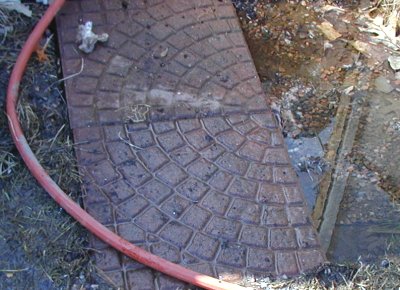
This is how the entry to the greenhouse looks this time of year.

greenhouse stoop

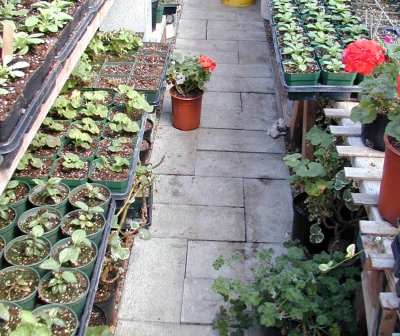
And this is what the greenhouse floor looks like.

greenhouse floor

Thanks to a bit of hard work and some pre planning we do not have to battle weeds or walk in mud.
The first year we put the greenhouse up we did not have time for a proper floor. That first year we only had time to get the new cover on and thaw things out. We had assembled the foundation and frame the past fall with the idea that we would put new plastic up the following spring.

That next spring we brought a salamander heater in to thaw things out. We did not have heat or ventilation yet but the electricity had been run out that past fall. Kristopher dug a 130 foot trench for the underground conduit that carries the 220 power, telephone and data cables.

Our property is the low spot in an area of more than 100 acres and so it tends to be wet in the spring. We must wear boots when we go back to work because some of the water is 6 inches deep.

So that first year we had a soggy mess in the greenhouse. We did not consider the water would pass under the foundation beams and into the greenhouse but it did. As a matter of fact it just about flowed through. But there was nothing we could do. We could not bring in stone because the ground would not support a truck and there was no way we were going to try and wheel barrow 10 tons of stone over the 130 foot long path.
Our first greenhouse floor was made up from pieces of landscape fabric over the turf that was on the floor. The fabric was held in place by the bench supports and until things dried up we had to wear boots in the greenhouse.

When things warmed up the grass and weeds began to grow where ever it could, pushing the cloth up in spots. This would never do.
In July, when the season began to draw down, we set our sights on the greenhouse floor. The original plan was to bury pex tubing in the floor and pump water from a water heater through it but we felt pressured to get something down and didn’t follow through with that plan. We decided that we could bury the tubing at a later date if we wanted to.

We wanted to use crushed red granite because we like the look but it is not so good to walk on. The granite is like little marbles and does not compact the way crush limestone does. Since we were going to have a set bench layout we decided to use paving blocks on top of the granite to make a level walking surface.

The first step was to remove the sod. That stuff really smelled bad because we had burred it under the fabric but it had to go. If we had left the sod it would have rotted, which would have smelled bad. In addition to the smell the rotting sod would not make a good base for the stone. So we cut it out and wheel barrow it away. The floor is 14 by 32 and this was the hardest part of the whole project.
After we cut the sod out and levelled the floor we began to bring the stone in. We had a dump truck deliver the stone, now that the ground would support the weight. It was a big pile but we made short work of filling the floor in.

But before we did the stone we put down 2 layers fabric to block mud. The last thing we wanted is mud being forced into the stone. We brought the stone up about 3 inches above the original level of the ground inside the greenhouse. The total depth of stone is about 6 inches. This way the water can flow through with out rising to a level that would make working difficult. It also makes a floor that self drains once the yard dries up, which is the time we are using a watering hose.

This floor is nice to work on and can be warm when the sun is baking on it. When we put the next house up the greenhouse floor will be crusher run lime stone. The next house will be wider and we want to be able to change the layout if we want to and the crusher run will make a nice strong and dry place to work.

Crushed limestone is graded into different sizes at the plant using screens. The stone we want to use is one of the last to pass through the screen and is called crusher run. It’s a mix of stones, the largest of which are about 1 inches down to limestone dust. The benefit of this mix it its ability to pack tight into a surface that will not move around when someone walks on it. This is not the case with the granite stone pea gravel that is uniform size and is like walking on a pile of gravel. It really never packs down.