Category Cooking and Recipes

Look, I made a Salad!

This is in response to a post I saw the other day on a social media site showing a pile of bacon and one small leaf of baby lettuce. I am not sure what the meaning of the post is but after we saw it we wanted salad. Cobb Salad we call it and we use everything in the kitchen along the way of fresh vegetables and some savory items in including some kind of animal protein and often more than one. Served along some chips of toasted pita bread this is a full delicious meal that is easy as making bacon.
I filed this under cooking but there was little cooking involved. OK I boiled a few eggs and a hand full of shrimp, and then there was the bacon, but the eggs and shrimp were boiled and the bacon was done in the oven so by my reckoning it could hardly count as cooking. Thick slab bacon cooks @ 425 for around 10 minutes or a little more depending on the desired crispness.

salad 2

The part of this salad we really like are the cool weather baby greens but any age is good. When we are coming out of a long protracted winter nothing is as nice as seeing new crops springing out of the soil. These include arugula, leaf lettuce, spinach, beet greens and more.
Buy them separately to tailor the mix to your liking or buy one of the premixed packs of seeds available from catalogs or farm supply stores. These tasty little shoots can be easily grown under lights or even a sunny window. Any size container will do and we like the 12 by 18 inch black plastic nursery flats. The flats are only a few inches deep but it’s OK since we are only interested in the baby greens and a plant a few inches tall does not have a huge root system.
A Word Of Caution* Unless you like fiery greens be careful of mixes that include mustard varieties. A few years ago we were cultivating green in the green house, ( redundant? ) and we each sampled some fresh mustard and we both agreed later we were fairly sure we were burning up from the inside out. But if you like this kind of burn go for it.
Another nice spicy addition would be radish sprouts. Crunchy and spicy.
If you do not grow them yourself then scout the farmers markets and find who has the varieties you are looking for. Some growers are happy to put in a stock of what you want if you come back week after week. Good for you and good for them.
If buying from the grocery store the same shopping around rule applies. Many smaller “whole food” store will have fresh greens. That said the specialty stores are liable to have high prices for quality greens out of season.
The nice thing about salad is its not an invention and its not a recipe. It’s what ever you want in a bowl with a fork.

shrimp and avocado salad

Putting up pickles

pot-of-pickles
Tonight we are putting up pickles, both bread and butter and dill. We grow 2 types of cukes for out pickles. Eureka for the bread and butter and regal for the dills. The eureka get fat and meaty for perfect bread and butter pickles while the regal stay smaller and tight for dills. It’s a bit of work but worth it for great pickles. By the looks of the vines we will probably do 2 or maybe even 3 more batches this season.

The summer squash is coming in great and the peppers are doing well also. We got the tomatoes in late but they are starting with some really nice sun sugar cherry tomatoes. In all we grew 7 types of cherry tomatoes including red, yellow, orange, white, black and others. The brandy-wine tomatoes are big but still green.
The peppers are getting big but the walls are still a bit thin. We fried some but for good eating they need to have thicker walls. Hopefully they will beef up in the next week or so.

Putting up pickles can be fun.

Picking and freezing Blueberries

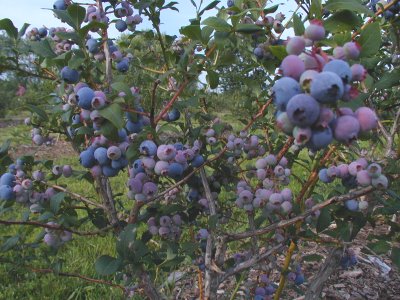
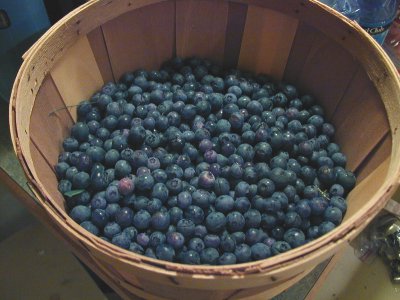
A week ago we had the opportunity to pick blueberries at Farnham Farms in Sandy Creek NY. We stumbled on the place by accident while picking up gift boxes for our wedding favors. We went on a weekday evening and there was a steady stream of customers picking. Wire baskets are provided for pricking and each basket holds about 9 or 10 pounds of berries.
2 types of blueberries were offered. A smaller sweeter and a large berry with a big blueberry flavor. The small bushes were brimming with ripe berries, so many that they could be picked with both hands. The larger berries were less plentiful but by no means skimpy. It was easy to pick a basked full from just a few bushes.

blueberry-bush1

blueberry-basket2

We transferred the berries to peck sized splint baskets to take home. The baskets were so full that we broke them into 2 baskets so the berries would not crush under their own weight.

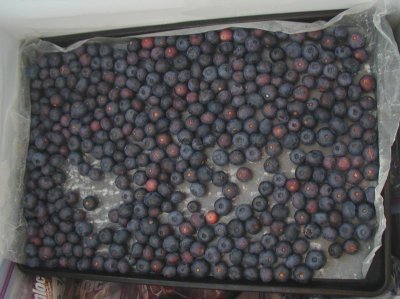
We brought the berries home and sorted out all the bad berries, stems, insects and other debris and froze them on cookie sheets covered with waxed paper. When they are frozen solid we put them in plastic bags for future use.

They can be thawed for pies, jam, fruit salads and muffins.
Now we have a stock of blueberries and strawberries to use until they come into season next year.

frozen-blueberries

Bread and Butter Pickles

Phyllis really likes bread and butter pickles and although I prefer garlic dills I have to admit a good bread and butter pickle goes with almost any sandwich. Well maybe not peanut butter.
I remember back when I was first exposed to this type of pickle, in my mothers canning cupboard. I was a little confused by the presents of many things that I did not consider to be pickle. Of course the cucumber was identifiable but why were there onions in there and what are those little round things and other strange looking ( to me ) things that settled to the bottom of the jar?
Since in those days, I did not pay much attention to my mothers canning, there was no way for me to know about the various spices and vegetables that were combined to give the bread and butter pickle its sweet and spicy flavor.

Fast forward to 2004 and we were getting ready to plant our first official garden at our new place. As the seeds began to arrive in March we noticed a pack of cucumbers that we did not order. I believe it was from Park Seeds. It was called the Eureka Cucumber and we were not sure we wanted to plant them. They looked a bit squat and stubby and not like a pealing cucumber at all. But waste not want not, we started some and set them out to grow on the stick fence that surrounds the asparagus garden. We put a few more of them in the row gardens with no staking.
The weather that year was a bit wet to begin with but they did well. We were really surprised at how fast they went from fingerling to full blown cukes. That is if you can call a 6″ by 2″ or 3″ cuke full blown. We sliced up a few and they were OK for eating but the trouble was they were coming in by the peck each day. We put some on the stand and they sold but we had many more than we could possibly deal with.

Since they were billed as a dual use cuke, for pickles and slicing, we decided to put some up. The fruits were rather fleshy with medium sized seeds and they would become fat and yellow in a day if we did not pick them in time. So we continued to picked them and kept them cool.
We decided to make both bread and butter and dill pickles but in the end we made 2 versions of the bread and butter and one of the dills. As it turned out they worked perfect for the former and not so hot for the latter. The problem with the dills is they were soft and opaque, and not to my liking. The kids on the other hand made short work of the dills.
We found the recipes at at the Minnesota cooperative extension web site. We use them a lot since their climate is similar to ours.

Our favorites were the spicy bread and butter pickle. We omitted the liming process and they were fine. The trick is to get them just as they are ripe, because if you wait a day more they become soft and not so good.

We have run out of pickles and we went to the store to see what was available. We were very disappointed when we found every version of bread and butter pickle had high fructose corn syrup as a sweetener. Except for one and that one had Splenda. This is a perfect example of why it is far better to put up your own. I am ordering the seeds this week.

Quick Marinara Sauce

Since food prepared with garden fresh ingredients tastes the best we will from time to time include our favorite recipes.

In most cases we will call for fresh ingredients but we will also try to give substitutions where we can.
This recipe is for tomato or marinara sauce. We started using this after realizing the caned or jar sauce contained too many things like corn syrup. With a little tinkering this can be altered to fit almost any situation. If it wants to be smooth like pizza sauce put it in the blender. We prefer to make it chunky for pasta and there is no reason this would not work equally well for pizza.

Use fresh tomatoes or canned. If you use fresh you may need to cook it a bit longer depending on the amount of liquid in the tomatoes. Mix up a few different types and colors for interesting flavors and a dramatic presentation.

OK here is what you need. Add or subtract to suite taste. For a larger quantity simply increase the ingredients in an equal ratio.

  • 2 cups of diced tomatoes, with about 1/2 cup juice. Substitute 1 large can.
  • 1 small can ( 6 oz ) tomato paste. Best to use a brand with no additives or spices.
  • 1 large onion.
  • 6 cloves garlic
  • Fresh basil to taste
  • Fresh Greek oregano to taste
  • Salt
  • Pepper
  • 2 tablespoons good extra virgin olive oil
  • 2 teaspoons balsamic vinegar
  • Turbinado sugar to taste ( start with one teaspoon ) Substitute table or brown.
  • Optional: Dried or fresh hot red pepper. To taste.

Dice the onion and mince the garlic. Put the onion and olive oil into stainless steel pot and cook on medium flame until the onions begin to turn translucent. Don’t add garlic yet.
Add the tomato paste and continue to cook over medium flame, stirring the paste constantly while it fries for about 1 minutes.

Now add garlic and fry for another minute. Do not burn the garlic. You could also substitute roasted garlic later in the recipe.

Add the tomatoes and stir to combine completely. Reduce the heat to low and let the sauce cook down to thicken for at least 5 minutes or more to desired thickness.

Now add minced herbs, vinegar and sugar, salt and pepper to taste. Adjust the sugar, salt, black pepper and red pepper. Reduce to final thickness.
Unused portions can be kept in the icebox for a week at the most.

Better to freeze it for use later.
To freeze portion try oiling cupcake tins with olive oil on a paper towel or spray oil. Ladle the sauce into the tins and freeze. Now put the frozen tomato pucks into a larger zip lock bag and keep in the freezer.

Options could include bell peppers, meat, wine or whatever.
This really is worth the small effort for a really great marinara sauce.

I made this video a while ago and decided to include it on this blog.