Purple Finch – April 8th 2015

I have been watching for a purple finch all winter.

This chunky little bird is about the size of a sparrow and brightly colored. I was very exciting to see a pair of them this afternoon.

purple finch

A member of the finch family, the scientific name is Haemorhous purpureus.

This little guy is a year round resident of our Northern NY. They seem a little more rare than the house finches or redpoll we get around the property. Some of them migrate South from Canada.

This batch may be headed back north and stopped by for a meal.

They were hitting the black oil sunflower seeds and loitering in the lilacs.

We will keep our eyes peeled and ears open for this one.

Learn more about the purple finch at Cornell University

Mourning Doves 5/5/2015

This pair of Mourning Doves had been hanging around all day in the lilacs.

Mourning Doves

I have heard these called Turtle Doves or Rain Doves but we usually refer to them as just Doves.

When they take flight their wings make a whistling swoopy sound and clicks. Other than that they make a cooing sound. They are not very timid and if careful, one can often walk right up to them.

They remind me of the pigeons I used to keep when I was young except the doves seem to be a bit smaller.

We see them feeding on the ground around the station picking up millet spilled by other birds. I personally have never seen one in a feeder. We were going to remove the millet from the feeder but it seems like the doves eat it on the ground so I don’t think it will hurt anything to continue with the seed. I think the sparrows eat millet and small seed too.

This pair has been around for about a week and I wonder if they are looking for a place for a nest. I think I will keep an eye on them. I hope they will not choose one of the soft maple tree we have tagged for removal.

From what I have learned Mourning Doves are monogamous so maybe this pair will treat us to some little ones.

Goldeneye Ducks 4/4/2015

Today we were headed to Oswego to photograph a lighthouse while there was still ice in the harbor but as it happens all too often we were visiting and the time flew by so we decided to postpone this particular adventure until we had more time and a better list of things to do.

Instead we headed down to Pillar Point to see if there was any ice piling up, as it does from time to time. No dice, no ice. At least the accumulation we were hoping to see.

However… we did see some water birds. They were a ways off and smallish so I pulled out the longest lens and took a few shots. Close up examination on a small camera screen is sometimes near impossible, especially when the subjects are so far away.

When we arrived home and pulled the files up on a bigger screen we confirmed they were goldeneye ducks.
It’s easy to tell why they earned that name. The eyes are brilliant yellow gold. The white cheek helps to identify them from a distance.

Even though they were quite a ways off we had fun watching them dive under the ice and appear in an other hole. This is about as close as we could get and the sun was not optimum but there will be more chances.

golden eye ducks

On a side note, these guys were really hustling and this is a hand held panning shot and fairly tight crop at that using my new 80-300 Nikon lens. I am beginning to like this lens and feel like it is a good addition to my bag.

Female Downy Woodpecker 4/4/2015

Late this evening and early this morning a soft sticky snow fell, covering the branches and feeders. This is not unusual for this part of the country as we are liable to get snow on the 4th of July.
That said, after a particularly cold and brutal winter we are looking forward to spring weather.

The birds were busy at the feeders tanking up as the temperatures were hovering around 30 degrees F. The Downy Woodpeckers spend time at the suet feeder. Phyllis makes a cake with rendered beef suet and peanut butter the birds seem to like, especially the woodpeckers.

Female Downy Woodpeckers are about 8 inches from tip to tail and a little bit smaller than the male. The female does not have the red patch on the back of the head.
Both the male and female are timid compared to a chickadee, who will sit close by on a branch and scold us until a fresh supply of black oil sunflower seeds is delivered.

We have observed the Female Downy Woodpecker taking smaller seed but they seem to like the suet feeders best and I know they go for bugs in the wild. This time of year there are not as many bugs readily available and the suet is easy.

Female Downy Woodpecker

Great Blue Heron 3/28/2015

This year the cold has held on and much of the wetlands are still frozen and covered in ice. This heron is one of a flock who had found an area of open water. They seemed to be hunting newly emerging amphibians or maybe small fish.
Great Blue Herons nest near here but migrate during the winter as they would not be able to feed. Our neighbors koi pond is a favorite haunt of the Heron.

Great Blue Heron Flying
Earlier in the day there were a score or more herons at this spot but by the time we arrived the number had dwindled to 2 stragglers and they took flight right away.
Learn more about the Great Blue Heron.

Great Blue Heron 2011

I photographed this Great Blue Heron in 2011 near Alexandria Bay NY.
The rain was pouring down and all I had was my d40 Nikon with the 18-55mm kit lens.

Great Blue Heron 2011

Since that time I have found better lenses are key to wild life photography. And patience.

Wild bird feeder filler

Filling bird feeders without spilling the seed can be a daunting task.

With all the feeder designs available it’s hard to come up with a technique that works with all of them.
Funnels are some help but using one requires 3 hands.

And don’t even think about pouring from the corner of a 40 lb bag of bird seed.
We have found this simple answer to the problem and it only costs the deposit on a 2 liter plastic bottle.

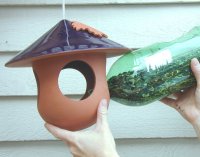
This method works with all the feeders we have around the property including our terra cotta avi-orb, wooden bin type and it works especially
well for the sock and tube thistle feeders.

Here the video showing how to make a feeder filler from a plastic soda bottle.
Step by step instruction are posted below as well


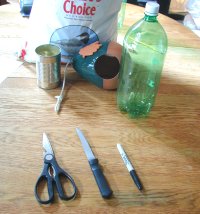
1. For materials all you need is a plastic 2 liter bottle.
For tools you will need a marker, a sharp pointed knife and a pair of scissors.

Almost any type of scissors will work, just don’t use the expensive ones your wife uses for sewing.
If you do then filling the feeders with be the lest of your problems.

A soup size tin can is used to charge the feeder filler.

feeder filler 1

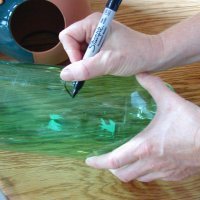
2. Draw a circle on one side of the bottle with the marker.

Make the about 2 inches from the bottom of the bottle.
Just freehand it.

If you want you could use anything round to trace a circle on the bottle.

Stop sniffing the marker.

feeder filler 2

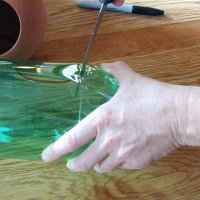
3. Carefully start a hole in the bottle using the sharp pointed knife.

Be really careful.

The best way to do this is to position the knife at the bottom of the circle which should also be at the bottom of the bottle.
The formed bottle bottom makes this spot the most ridged of any spot along the side.
Use a quick thrust making sure the sharp part of the knife is facing away from your hand.
The object is to make a small slit 1/2 to 1 inch long where the scissors can start the cut.

feeder filler 3

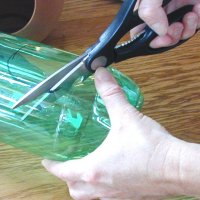
4. Use the scissors to cut around the circle until you have a hole in the bottle.

You could use the knife to make the cut but the scissors are easier and safer.

Make sure you recycle the scrap that was cut away.

What ever you do, don’t put plastic in refuse you are planing to burn.

feeder filler 4

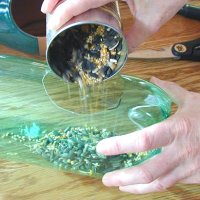
5. A soup size tin can works great for charging the feeder filler with seed.

Any type or size wild bird feed works.

The filler is especially good for filling tube thistle feeders, especially the cloth socks.

Leave the cap on until you are ready to fill a feeder, then replace the cap to keep the seed from falling out of the hole.

Feeder filler 5

6. Keep the hole on top while you fill the bird feeders.

You could use a larger or smaller bottle depending on the size of your feeders and your ability to handle a large bottle.
Keep the filler and the soup can right in with your bird feed.

Always use fresh feed and keep it covered and dry.

Metal cans with locking lids prevent rodents from getting into the feed bin.

feeder filler 6

Dealing with nesting starlings

About 2 weeks ago we were awaken by squawking and scratching outside our bedroom window. By the sounds of squeaks and whistles we knew the culprits were Starlings.

It seemed they had found a small opening in the siding and were fixing to take up housekeeping in the wall of our house. We bought this old house a few years ago and have not been able to finish repairs to the siding. If there is a small opening the Starlings will find it and fill it with sticks, grass, string and baby Starlings.

The only way to deter them is to block off the opening. A simple piece of board and some galvanized nails fixed the problem. Of course we made sure there were no starlings in the wall before we blocked off the entrance.

Early the next morning the birds returned to continue the project only to find the door had been nailed shut. They hung around for a few minutes and then left. They have not returned.

Female snowy owl

Today as we were driving we noticed a large owl perched on the top of an old abandoned school house. This was one of those one room survivors that someone has maintained and it sits in an area with no trees or brush, just vacant field.

At first it looked as if it might have been one of those “fake owls” used to keep other birds away. We turned around and went back to see that it was a very large dirty white/grey with a very round head. She did not pay strict attention to us but she kept an eye on us.

Unfortunately we did not have one frame left in the camera so we were not able to get a photo. Finally she flew away and the wing spread must have been almost 4 feet. She glided to the top of a telephone pole, probably waiting to find dinner.

We will go back in a day or some with the camera and try to get a photo.

Robins are back

A sure sign of spring is the return of the robins. We began to notice them about a week ago and now they seem to be everywhere.

They spend winters in roots from just below Canada south to Florida. This disappearing act has given rise to the idea that they fly south for the winter.

We don’t see them at the feeders but that does not mean they don’t stop by.

It seems like the pickens are slim for robins but it is not as bad as for some other species that eat only bugs. Robins can eat fruit to tide them over in the winter when it would be a real trick to coax an earthworm from the ground.