Category Zone 4 Gardening

Drop down greenhouse benches

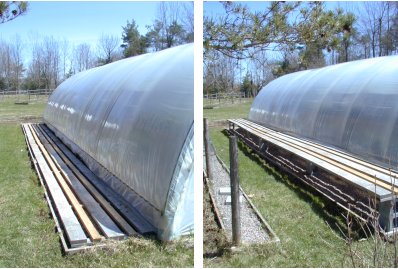
We made these drop down greenhouse benches so the snow blower would not send all the stone into the yard and in the summer they do double duty as plant stands.

We used larch, which is a very durable wood. We prefer larch to pressure treated lumber as there are no chemicals used. It’s naturally suited for use outdoors.
Here’s how the benches work.

benches
Laid down they make a path for the snow blower.
Up they make benches for plants and space underneath for tidy storage.

We use a framework on the ground to contain the granite gravel. The gravel is laid on top of landscape fabric so weeds and plants do not come up through.

Cinder blocks hold the benches up in the summer.

Wedding site done, back to work

At last The Wedding Department page is finished and uploaded so we can continue with other things, like work. There will still be some tinkering to do but at least the basic architecture is there.

The weather today was in the low 80s and its a good thing we built the small greenhouse with a removable side. Even with the side off it was over 80 inside. The weather is going to go back down to the 50s and that is a good thing. If the weather stayed warm we would be forced to put the shade cloth on the greenhouse.

The shade cloth cuts the sun 60 percent and that is not what we want this time of year. The plants that want sun “need sun” to look the best and stay healthy. To much cloudy weather or using the shade cloth will make the plants leggy. The cool weather will allow us to leave the shade cloth off and still take advantage of the light. Even a cloudy day has more sun than a 60 percent shade.

We are making good strides in the gardens. The perennial bed is cleaned up and edged around the border. Its always a mystery what will come up so we just watch and cross our fingers. Some of the plants are starting to show like the lupines, the Shasta daisy’s, sedum and that yellow stuff that Phyllis got from her sister the used to be around the bird bath in Black River. Can’t remember the name and we did not get any pictures but its coming up in good shape.

Hold it, Phyllis just said its Yellow Loosestrife, not to be confused with the intrusive Purple that chokes swamps. Although it is very prolific.

We put the benches up on the side of the greenhouse, see the photos. The benches are made of larch which is the Monty Python term for tamarack. Its so full of pitch that it does not rot. We use larch for the foundation of the greenhouse and anywhere we need wood that will be in contact with the ground, with the exception of cedar posts. For years prior to pressure treated lumber larch was used as the wood posts that supported road way guard rails.

It requires no finishing and weathers to a nice soft gray.
We put stone around the outside of the greenhouses, 3 feet out on all sides. The stone is held in place by 1 by 4 larch that we anchored with pipe driven into the ground. We laid landscape fabric down and covered it with small red granite. This way we do not have to weed under the benches. It is really tidy because we can use the weed whacker against the boards to trim the grass. The mower gets the paths.

In the summer the benches are supported with regular cinder blocks. This gives them a nice height and there is space under the benches for storage. Some plants can be placed on the gravel to save space. This system works good in the early spring when the days are warm but the nights may be cold. We can just hustle the plants under the benches and if its really cold we can put some plastic on the benches to protect the plants. Next morning they go back on the benches. This is a lot better for plants than just covering them with plastic as the strong morning sun will not cook them as can happen when plants are covered with out ventilation.

In the winter we lay the benches flat on the gravel to make a road for the snow blower. They have to be stored some where. The snow must be kept clear around the greenhouses and the snow blower would pick the stone up if we just ran it around with out the benches in place.

So we have them up and the hearty herbs are being brought out. We put them under the benches for a day or 2 to harden them to the wind. Its amazing as to how well plants respond to getting out doors in the breeze. The English daisy’s were limp and lifeless but 2 days under the benches and they are holding their leaves up.

So time to hit the hay. Its been a long weekend.

Another nice day !

The sun shone again and it is really working to dry things up. And the weather is coming around to where we can put some things out. We had to pick up more cement blocks because our supply has become depleted with the temporary greenhouse benches. Seems like another nice day indeed.

Normally we do not think much of using pallets for benches because they are usually big, heavy, bulky and greasy, however we made a lucky find that changed our minds.
When we built the new temporary greenhouse we did not build it with the intention of using it for a greenhouse forever. So there was not a lot of thought about benches but when we were finished building we had to face the fact that unless we were going to put the plants on the ground we needed something for benches.

So off to town we went in search of something to use. We considered every thing we saw. Perhaps if we found some abandoned shopping carts we could cut the bottoms and the sides out. After all they would not rot and air would circulate, but what would we do with all the cart carcasses. It might look fishy to see a lot of shopping cart parts in front of the house, out for the trash. Not to mention the karma thing.

After a lot of looking at the lumber and hardware stores we were about to call it a day when we happened by a local commercial trucking firm. To our surprise, out in front by the drive and stacked for the taking were the nicest little pallets we ever saw. And we just happened to have the truck.

They are 2 feet by 4 feet and perfectly clean. Nice and light, easy to handle, and free. It just takes 2 cement blocks to hold them up and each one will accommodate 4 flats. On the blocks they are at a nice height for working.

Then when we are finished we can stack them very neatly and cover them with a green tarp making them invisible. Of course one of the property rules is that anything left in the same spot for more than a week becomes invisible anyway but if we use the tarp it gives the impression that we are at least trying, even if we are really slacking.

Anyway they used up all the cement blocks so we had to get more for the benches around the greenhouse. We will have enough blocks for a good sized foundation before long and moving them around will give us good biceps to boot.

What a difference a day makes

The sun came out today with a vengeance. What a difference a day makes in the garden.

This is exactly what we need. The weather has been gray for some time and not only is it depressing the cloudy conditions make the plants leggy. The tomatoes especially. We managed to put up about 8 flats and the idea was to get them buried up to their necks.

Some people wait until there are 2 sets of true leaves but in this case the seedlings were going to be more than 2″ tall and if we had waited one more day they would be too tall to work with.
This way we can put them in the sun and they will grow wide. We will probably pinch them in a week and that will help a lot. The weather report looks like nice bright days for the coming week at least and that will help dry things out. And with a little luck we can put a lot of the herbs and plants like Johnny Jump Ups and Pansies out, making more room for tomatoes and peppers.

Another bit of sun came into the greenhouse today. We were not thinking about school being out as we were busy feeding and planting up. There was a noise at the door and there stood Miranda. She is one of the local kids who come buy in the summer and help with chores like watering plants, washing equipment and generally making fun contributions to the general atmosphere. She was checking to see if her job was going to be open this season.

We chatted and caught up on the going on. She cleaned up a bunch of geraniums that had been on our list to do but somehow did not move to the head of the “things to do now” list, then left with a plant for her mother. With our kids living away its nice to have some one to nurture.

And so now its midnight. I was suppose to get to bed but seeing as how some one did not put enough hours in today I will have to stay up a while longer. I must finish the wedding dept page for the relaunch as it is hanging over my head. Maybe if we had not spent part of the afternoon tramping around the woods on the island ….. oh well, life is too short not to tramp around the woods.

Snows going but the water is staying

Its been above freezing for the last 24 hours which means all the snow is melting.
The trouble is it is turning back into water which collects in the back yard.
We were not considering that when we bought the place but I can still hear Don Doney’s words echoing in my head, “always buy a house on a hill”.

The trouble is this place was available for a really really good price and we were considering the favorable electricity rate, not the geography.

Upon reflection, the fact that the back yard was inhabited with frogs, and snakes, and the ground seemed rather spongy when we first looked at it should have told us something. It turns out the well is the lowest spot in all directions, for as far as you choose to look. The good thing is the well can be used to water plants.

I would rather not wear my boots to go to the gardens or greenhouse. When I went out this morning I figured Phyllis was in the studio because there were no foot prints in the slush and I was supprised that she was in the greenhouse when I got there. Turns out she went way around on the neighbors property and then along the side of the greenhouse, walking on the benches to get in, all because she did not have her boots on.

And so that’s the way it goes back there. We would like to have a raised walkway sometime but we do not wish to restrict truck access to the back of the lot. Maybe a floating bridge.

On another note the peppers, which we thought were vole chow, started to come up. It looked as if the voles had eaten them all before they sprouted so we ordered more seeds. The flats were put on the center benches to see what would happen. Lo and behold there are peppers sprouting every where. But no husk cherrys. More seeds are on the way and we can plant them when they come.

First Post

Well ok, its about time we started putting some of this down. An online journal of sorts. Since we spend a goodly amount of time in the gardens, the greenhouse and with our noses in books and catalogs we should not run out of topics for the foreseeable future.So last night we got a surprise, by seasonal standards, snow shower.

It was about 3 or 4 inches of the wettest heaviest snow blower gagging snow this season and hopefully the last.Phyllis got up first thing and removed the snow from the top of the temporary green house. We were not expecting anymore snow so we built it with a low pitch to save time and make it easier to put the plastic on. It left the plastic a bit sagging but not too bad. It will last for as long as we need it.The plows left a foot and a half berm at the end of the driveway and it was like concrete.

The snowblower chute clogged every 2 minutes. While I was cleaning the chute my thoughts drifted back to when a friends father was clearing the chute of his snow blower and lost parts of his fingers in the process. Even though the motor was not running there was pressure on the belt, enough to sever several digits. We used a stick.

Anyway its raining now and hopefully this crap will be melted and gone in a day or so. This Friday is suppose to be in the 60’s. We need to get some of the plants out of the greenhouse soon or it will explode.

Surprise greenhouse inspection

This morning our New York State Ag inspector paid us an surprise greenhouse inspection visit just as he does each year. The state likes to keep tabs on us and this is only one way they do it.First since we are a business we are obligated to collect state sales tax. We keep track and file paper work 4 times a year, sending them a check for what we collected each quarter less some very small percent for our trouble.Next since we grow the products we sell we are obliged to pay a fee for a permit to do so and we are inspected once a year.
We also have a state inspected kitchen but for some reason that was a one time deal and there was only a one time fee.

Last since I am a certified wild life rehabilitator there was a fee, tests, and more paper work to be submitted.

Sometimes it seems like they could save some money by setting up an office in the spare room. At least we would save the postage.

The greenhouse inspector looks over the plants to make sure they are healthy and pest free. He also looks over the greenhouse to be sure we are following good practices. He has always been helpful and offers suggestions when in the past there might have been issues. This is not to say we had any big problems, but when we were starting up we wanted to be sure we were conforming to the rules and regulations.

Keeping the greenhouse free of pests is not so hard as we were led to believe. When we were just beginning we were talking with a fellow greenhouse owner and we mentioned that we intended to use only organic means of pest control. He was doubtful that we would be able to control pests with out the modern pesticides, particularly since we keep the greenhouse heated in the winter.

For the first year we had no problem at all but into the second year we began to see aphids on some plants. This was a big disappointment as we were under the impression that if we kept the house in order and inspected every plant brought in we would have no problem.

After talking with some other greenhouse operators we realized that aphids are a very common occurrence.
The trouble is we keep the greenhouse working except for a few months in the summer when it is too hot. During the summer we empty the house and take the shade cloth off. The temperature inside sores to more than 130 f and that helps to kill bugs. We also disinfect the benches with a 9 to one Clorox solution. ( nine parts water, one part Clorox. ) In the fall we bring plants in from outdoors and that is when we began to see aphids.

We used soap water and we picked them off by hand. We captured hundreds of lady bug beetles and let them go to work. The beetles would fly to the plastic and bask in the sun. They did not seem to be doing much at all in the eating aphids department.

Then one day while re potting a plant we notices a very fierce looking bug. It was black and orange and looked like a small crocodile. I went to our library and looked in the insect field guide to find that this was in fact, a lady bug beetle larvae. It turns out the larvae will eat more aphids than an adult and as a matter of fact they ate all the aphids in the greenhouse. With all the prey, ( food ) gone the predators, ( lady bug beetles ) disappeared to who knows where. And we were back to square one again.
This method was not going to work out for us. We could not catch enough beetles. The beetles would not stay when there was no prey and we were not willing to pay for mail order bugs. There had to be a better way for us.

After looking around we found a product called pyola. Its a combination of emulsified canola oil and pyrethrins which are derived from plants. Its safe to use, not harmful to the environment and , safe to use, and not too expensive. We mix it up in a sprayer and go through the greenhouse once every 7 to 10 days.

Insects can not form an immunity to oil and it works on all stages including eggs. I have read that you could go to the supermarket and get canola oil, mix it with soap and use that but for my money the pyola works fine so why bother just to save a few bucks. We found it best to use a pressure sprayer with are really good nozzle. Not a cheap wal mart plastic junk sprayer but one of the really nice enamel lined metal ones with adjustable, and cleanable, brass nozzle. The finer the spray the better the coverage. The long wand lets you direct the spray into and under all the leaves and this would be a problem when using a bottle type hand sprayer.

Not that bottle sprayers are not useful for a smaller number of plants. We recommend adding a sprayer used for cow udders to your arsenal. These ingenious hand held trigger type spray bottles have the sprayer head pointing up. Farmers use them to spray disinfectant on the cows udders prior to milking. Real handy for spraying ferns too. If you can not find one locally, these guys have them.
http://www.valleyvet.com

SO anywze…
The inspector looked around, poked some plants, shook others over his clipboard and that was it. We passed again and are now officially endorsed by the State of New York.
Its ironic though, the state is so fussy about inspecting the greenhouse for bugs but when it comes to our kitchen, where we are certified to prepare food for sale, the inspection was a one time affair and that’s all.

Think about it. Where is the potential for the greatest direct harm to the public. Selling you a plant with an aphid, when the chances are the plant could get them anyway, or fixing jam, cakes cookies and pies and handling food with out washing my hands after using the bathroom. Something to think about at the farmers market.
Who wants cookies ???